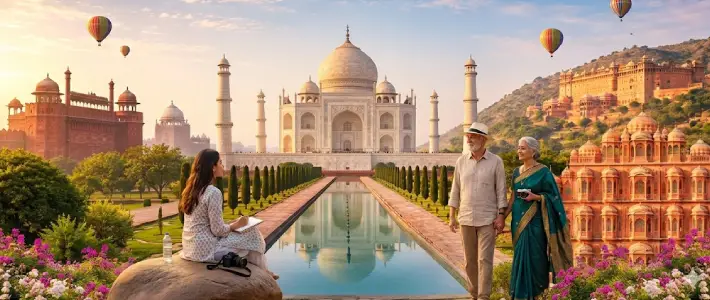
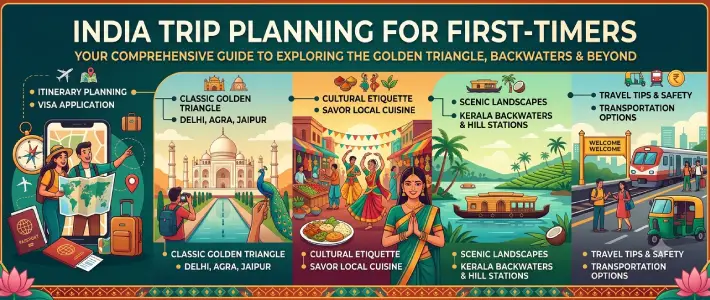
India is not merely a destination; a journey through India is an unforgettable, lifelong experience. It is a nation of 1.47 billion people, comprising 28 states and 8 union territories, and is home to a living civilization that dates back nearly 2000 years. India is a land of immense diversity, spanning royal heritage, culture, religions, festivals, and cuisine. From the architectural marvel of the Taj Mahal and the spiritual ghats of Varanasi to the tiger reserves of Madhya Pradesh and the backwaters of Kerala, the entire country embodies” Unity in Diversity”.
This 2026 India Travel Guide is designed to provide all the information you need for a safe, adventurous, and well-planned trip– one that allows you to witness and experience every facet of India, creating memories that will last a lifetime.
This guide covers:
- India at a Glance - key facts for first-time visitors
- Tourist Visa Requirements - e-visa process, fees, exemptions
- Currency and Budget Guide - daily cost estimates for all traveller types
- Travel Options - how to get around India's vast geography
- Health and Safety - vaccinations, food, insurance, and precautions
- Best Time to Visit India - season-wise and month-wise breakdown
- Top Destinations - state and region-wise highlights
- Practical Travel Tips - packing, etiquette, money, SIM cards
- Top India Itineraries for 2026-27 Season
India at a Glance
Before planning any trip, it helps to understand the basics. Here are the essential facts about India:
|
Category |
Details |
|---|---|
|
Location |
South Asia - Northeastern Hemisphere |
|
Capital |
New Delhi |
|
Area |
3.287 million sq. km (7th largest country in the world) |
|
Population |
1.47 billion (most populous country in the world) |
|
Administrative Divisions |
28 States and 8 Union Territories |
|
Official Languages |
Hindi and English (22 scheduled languages; 1,600+ dialects) |
|
Currency |
Indian Rupee (INR) |
|
Time Zone |
Indian Standard Time (IST) - GMT+5:30 (no daylight saving) |
|
International Dialling Code |
+91 |
|
Major Religions |
Hinduism, Islam, Christianity, Sikhism, Buddhism, Jainism |
|
Electricity |
230V / 50Hz - Type C, D, and M plugs; carry a universal adapter |
|
Internet |
4G/5G is widely available; eSIM and local SIM are available at airports |
Tourist Visa Requirements for India
Most foreign nationals require a visa to enter India. The Indian government offers two primary routes: the e-visa (electronic) and the regular sticker visa through an embassy or consulate. Both are valid for tourism purposes.
Types of Tourist Visa
e-Tourist Visa (eTV): Available to citizens of over 160 countries. Applied entirely online. Three validity options:
- 30 days - double-entry (from date of first arrival)
- 1 year - multiple-entry (from date of grant)
- 5 years - multiple-entry (from date of grant)
Regular Visa: Applied through the Indian embassy or consulate in your country, for nationals of countries not eligible for e-visa, or travellers with specific circumstances (e.g., Pakistani passport holders, some journalists).
Passport Requirements
- Minimum 6 months' validity beyond your intended return date
- At least 2 blank pages for immigration stamps
- Passports with only amendment/endorsement pages remaining are not accepted
How to Apply for an e-Visa - Step by Step
- Visit the official portal: indianvisaonline.gov.in
- Select 'e-Tourist Visa' and fill in your personal details, passport information, and travel dates
- Upload a recent passport-size photograph (white background) and a scanned copy of your passport bio page
- Pay the visa fee online by credit or debit card (fee varies by nationality and duration)
- Receive your Electronic Travel Authorisation (ETA) via email within 72–96 hours
- Print the ETA and carry it with your passport when you arrive in India
IMP: Apply at least 4–7 days before departure. During peak season (October–February), processing can take slightly longer. Do not apply more than 120 days before your intended arrival date.
Visa-Exempt and Special Categories
- Citizens of Nepal, Bhutan, and the Maldives do not require a visa and can enter freely
- OCI (Overseas Citizen of India) cardholders - do not require a visa but must carry a valid passport
- Citizens of Japan, South Korea, and the UAE - eligible for Visa on Arrival for business/medical conferences (up to 60 days)
Note: Extensions: e-visa extensions are not possible from within India. If you need to stay longer, you must exit and reapply. Always check the latest entry requirements on the official website before traveling, as policies are subject to change.
Currency and Budget Guide
Currency
India's official currency is the Indian Rupee (INR). As of 2026, the approximate exchange rate is 1 USD ≈ INR 93–97 (rates fluctuate - check live rates before departure).
Cash vs Cards: Credit and debit cards (Visa, Mastercard) are widely accepted in hotels, restaurants, and shops in major cities. However, cash remains essential in smaller towns, rural areas, local markets (bazaars), auto-rickshaws, and at most religious sites. Always carry a mix of both.
Currency Exchange: Available at international airports, nationalised and private banks, and RBI-authorised money changers. Avoid exchanging at hotels, as rates are typically less favourable. ATMs (including international-card-compatible ones) are available across all major cities and tourist areas.
UPI Payments: India's Digital Payment Revolution. QR code-based UPI payments are ubiquitous - from street vendors to luxury hotels. International visitors with compatible bank apps can sometimes access UPI; check with your bank before departure.
Budget Guide - Daily Cost Estimates (2026)
|
Category |
Budget Traveller |
Mid-Range Traveller |
Luxury Traveller |
|---|---|---|---|
|
Accommodation (per night) |
INR 800–1,500 (~$9–17) |
INR 2,000–5,000 (~$24–60) |
INR 10,000+ (~$120+) |
|
Food (per day) |
INR 300–600 (~$4–7) |
INR 700–1,200 (~$8–14) |
INR 2,000–4,000 (~$24–48) |
|
Transport (per day) |
INR 200–500 (~$3–6) |
INR 500–1,500 (~$6–18) |
INR 1,500–4,000 (~$18–48) |
|
Activities (per day) |
INR 200–500 (~$3–6) |
INR 500–1,000 (~$6–12) |
INR 1,000–3,000 (~$12–36) |
|
Estimated Daily Total |
INR 1,500–3,100 (~$18–37) |
INR 3,700–8,700 (~$44–104) |
INR 14,500+ (~$174+) |
Note: Daily total estimates are approximate and based on 14+ nights of travel. Entry tickets for major monuments (Taj Mahal: INR 1,100 for foreign nationals), shopping, SIM cards, and travel insurance are additional. Rajasthan, Goa, and Himachal tend to be slightly more expensive for accommodation than less-visited regions.
Getting Around India - Transport Options
India is a vast country - approximately 3,000 km from north to south and 3,000 km from east to west. Choosing the right mode of transport for each leg of your journey is one of the most important planning decisions you will make.
Domestic Flights
For distances over 500 km, flying is by far the most time-efficient option. India has a rapidly expanding aviation sector with competitive fares. Major carriers include IndiGo, Air India, SpiceJet, and Vistara (now merged with Air India). Book 3–6 weeks in advance for the best fares. Most major cities and tourist hubs have well-connected airports.
Travel Tip: Jaipur, Udaipur, Jodhpur, Varanasi, Kochi, and Goa all have direct flights from Delhi and Mumbai - ideal for multi-city India itineraries.
Indian Railways
India's railway network is one of the largest in the world, covering over 68,000 km of track and connecting virtually every city and town. For travellers, trains offer an immersive, affordable, and comfortable experience - especially in AC 2-Tier and AC 3-Tier classes.
Premium trains to know: Rajdhani Express (fastest inter-city), Shatabdi Express (same-day return), Vande Bharat Express (modern high-speed), and the Palace on Wheels (luxury tourist circuit through Rajasthan).
Booking: Book through irctc.co.in. International travellers can use the foreign tourist quota, which is a small allocation of reserved seats at each station. Book at least 30–60 days in advance during peak season.
Private Cab and Car Rental
For travel within a city, between cities, or on a multi-destination tour, a private cab or self-drive car rental offers maximum flexibility. Pre-booked cab services are the preferred choice for airport transfers, sightseeing circuits, and outstation day trips - with verified drivers, fixed fares, and no surge pricing.
In Rajasthan, dedicated cab operators cover routes, Jaipur–Agra, Jaipur–Udaipur, Jaipur–Jaisalmer, and multi-city Rajasthan circuits with experienced drivers who know local routes, timings, and sightseeing stops.
App-Based Cabs & Government Alternatives (Ola, Uber, and Bharat Taxi)
Ola and Uber operate in most major Indian cities and are convenient for short, urban transfers. However, availability can be inconsistent in smaller towns and outskirts, and surge pricing during peak hours can make them significantly more expensive than pre-booked fixed-fare operators. To counter these private monopolies, the Indian government has backed Bharat Taxi, a driver-owned cooperative initiative launched under the Ministry of Cooperation. Operating on a zero-commission model, it offers commuters surge-free, predictable pricing while providing drivers with direct ownership and social security benefits. While Bharat Taxi expands its footprint across major hubs like Delhi-NCR, Gujarat, Mumbai, and Jaipur, a dedicated traditional cab service is still strongly recommended for outstation travel and multi-day itineraries.
Auto-Rickshaws, E-Rickshaws, and Local Buses
Auto-rickshaws are the essential last-mile transport in every Indian city. Always agree on a fare before getting in, or insist on the meter. E-rickshaws are increasingly common in historic areas where motorised vehicles are restricted. State-run and private buses connect smaller towns but are best suited to budget travellers with flexible time.
Metro and Local Rail
Delhi, Mumbai, Bangalore, Hyderabad, Chennai, Kochi, and Jaipur all have metro rail systems - clean, fast, and affordable. Jaipur Metro covers key areas of the city, including the Old City. Mumbai's local train network is essential for navigating.
Water Transport
Kerala's backwaters are best explored by houseboat (kettuvallam) - an overnight cruise on Alleppey's canals is one of India's most iconic travel experiences. Andaman Island ferries, river cruises on the Ganges in Varanasi, and Goa's river ferries also offer memorable water-based journeys.
Health and Safety Requirements
India is safe for most travellers with proper preparation. The key health risks are preventable with the right vaccinations, food hygiene practices, and travel insurance.
Recommended Vaccinations
Consult your doctor or a travel medicine clinic at least 4–6 weeks before departure. Standard recommendations include:
- Hepatitis A and Hepatitis B - recommended for all travellers
- Typhoid - recommended, especially for longer stays or rural itineraries
- Tetanus, Diphtheria, and Pertussis (Tdap) - ensure current
- Rabies - recommended for travellers spending extended time in rural areas or working with animals
- Malaria prophylaxis - advised for travellers visiting Rajasthan, Madhya Pradesh, Odisha, and the Northeast; consult your physician for the appropriate medication
- Yellow fever vaccination certificate - mandatory for travellers arriving from yellow fever-endemic countries
Food and Water Safety
Traveller's diarrhoea is the most common health complaint for visitors to India. Precautions are straightforward:
- Drink only sealed bottled water or use a water purification bottle or tablets
- Avoid ice in drinks unless you are certain it is made from purified water
- Eat freshly cooked food from busy, reputable establishments - busy stalls have higher turnover and fresher ingredients
- Carry ORS (Oral Rehydration Salts), a basic antibiotic (prescribed by your doctor), and antidiarrheal medication
- Carry a hand sanitiser and use it consistently - especially before meals
Travel Health Insurance
Travel health insurance is not legally mandatory for India but is strongly recommended. India's private healthcare system in major cities is of a high standard, but can be expensive without coverage. A comprehensive policy should include:
- Emergency medical treatment and hospitalisation
- Emergency medical evacuation and repatriation
- Trip interruption and cancellation coverage
- Baggage loss and delay
- Personal liability
- 24/7 emergency assistance helpline
Note: Always carry printed copies of your insurance certificate, policy ID number, and the 24/7 emergency contact number. Keep digital copies in a cloud folder accessible from your phone.
General Safety
- India is generally safe for tourists, but exercise standard precautions in crowded areas - keep valuables in a money belt or inner pocket
- Use only registered, prepaid taxis or pre-booked cab services - avoid unmarked taxis at airports or railway stations
- Solo women travellers should prefer well-reviewed accommodation, travel during daylight hours where possible, and inform someone of their itinerary
- Download the tourist helpline app or save the national tourist helpline number: 1800111363
Best Time to Visit India - Season and Month-Wise Guide
India's vast geography means there is truly no single 'best time' - it depends on where you are going. The country spans tropical beaches, high Himalayan passes, arid deserts, equatorial rainforests, and temperate plateaus. Here is a complete breakdown.
Season Overview
|
Season |
Months |
Best Regions |
Ideal For |
|---|---|---|---|
|
Winter (Peak) |
Oct–March |
Rajasthan, UP, South India, Goa, Kerala |
Heritage, culture, wildlife, beaches, festivals |
|
Summer |
April–June |
Himachal, Uttarakhand, Ladakh, J&K, Southern Hills |
Trekking, hill stations, scenic drives |
|
Monsoon |
July–September |
Kerala, Western Ghats, Goa, Northeast |
Ayurveda, wellness, waterfalls, lush landscapes |
Winter - October to March (Peak Tourist Season)
Winter is the best time to visit most of India. Daytime temperatures range from 10°C to 25°C across the plains, and skies are clear and blue. This is the ideal season for the Golden Triangle (Delhi, Agra, Jaipur), Rajasthan's palaces and deserts, South India's temples and beaches, and wildlife safaris in Ranthambore, Jim Corbett, and Kaziranga.
Best destinations: Rajasthan, Uttar Pradesh, Delhi, Agra, Varanasi, Kerala, Goa, Tamil Nadu, Odisha, Madhya Pradesh (wildlife parks), and most of India's heritage circuits.
Festivals: Diwali (Oct–Nov), Pushkar Camel Fair (Nov), Christmas & New Year (Dec–Jan), Republic Day (Jan 26), Holi (Feb–Mar).
Summer - April to June
Summer is best for India's Himalayan regions. Temperatures exceed 40°C in Rajasthan and the Indo-Gangetic belt, making travel there uncomfortable. However, Himachal Pradesh, Uttarakhand, Ladakh, and Jammu & Kashmir become perfectly accessible - with open mountain passes, wildflower meadows, and clear trekking conditions.
Best destinations: Shimla, Manali, Dharamshala, Spiti Valley, Rishikesh, Leh-Ladakh, Nainital, Mussoorie, Coorg, Munnar, Ooty, Andaman & Nicobar Islands.
Note: Ladakh is only accessible from approximately May to October - the mountain passes remain snow-blocked in winter. Book Leh accommodation and permits well in advance for June.
Monsoon - July to September
The monsoon divides India dramatically. While the plains become humid and some monuments close due to flooding risks, the Western Ghats, Kerala, Goa, and the Northeast transform into lush, waterfall-rich landscapes. This is also the best season for Ayurvedic treatments in Kerala, as the humidity is believed to make the skin more receptive to therapies.
Best destinations: Kerala (backwaters and Ayurveda), Munnar and Wayanad (tea estates), Goa (off-season peace and lush hills), Ladakh (rain shadow - stays dry), Meghalaya (one of the wettest places on earth - dramatic beauty), Coorg (waterfalls).
Month-by-Month Quick Reference
|
Month |
Weather |
Best Regions |
Key Festivals |
|---|---|---|---|
|
January |
Cool–Cold (5°C–25°C N. India) |
Golden Triangle, Rajasthan, Goa, Kerala |
Republic Day, Pongal, Makar Sankranti, Bikaner Camel Fest |
|
February |
Pleasant (10°C–32°C) |
Rajasthan, Himachal, Goa, Kerala |
Khajuraho Dance Fest, Rann Utsav, Goa Carnival, Vasant Panchami |
|
March |
Warm (15°C–35°C) |
Rajasthan, UP, Himachal, Goa |
Holi (Mathura/Vrindavan), Gangaur (Jaipur), Attukal Pongala |
|
April |
Hot (25°C–40°C plains) |
Darjeeling, Shimla, Manali, Rajasthan |
Baisakhi, Bihu (Assam), Tamil New Year, Ram Navami |
|
May |
Very hot plains; cool hills |
Manali, Spiti, Ladakh, Andaman, Ooty, Shillong |
Buddha Purnima |
|
June |
Pre-monsoon + showers |
Char Dham, Ladakh, Manali, Mount Abu |
Hemis Festival (Ladakh), Rath Yatra (early) |
|
July |
Heavy monsoon |
Goa, Maharashtra, Kerala, Munnar, Darjeeling |
Rath Yatra (Puri), Guru Purnima, Teej (Rajasthan) |
|
August |
Warm & humid monsoon |
Kerala, Western Ghats, Meghalaya, Rajasthan |
Independence Day, Onam (early), Ganesh Chaturthi |
|
September |
Monsoon tapering |
Ladakh, Kolkata, Munnar, Kerala |
Ganesh Chaturthi, Onam (Kerala), Marwar Festival |
|
October |
Ideal - cool & clear |
Pan-India: Rajasthan, UP, Himachal, Kerala |
Navratri, Durga Puja, Dussehra, Pushkar Fair (starts) |
|
November |
Best month - moderate |
Rajasthan, Goa, Kerala, Varanasi, Karnataka |
Diwali, Pushkar Camel Fair, Rann Utsav, Hampi Utsav |
|
December |
Cool N. India; mild South |
Golden Triangle, Goa, Kerala, Shimla, Rajasthan |
Christmas (Goa), Hornbill Fest (Nagaland), New Year |
Top Destinations in India - Region-Wise Guide
India has hundreds of destinations worth visiting. Below is a curated region-wise overview of the most significant - chosen for cultural richness, accessibility, and traveller experience.
|
Region |
Top Destinations |
Must-See Highlights |
|---|---|---|
|
North India |
Delhi, Agra, Jaipur, Varanasi, Amritsar |
Taj Mahal, Red Fort, Amber Fort, Golden Temple, Varanasi Ghats |
|
Rajasthan |
Jaipur, Udaipur, Jaisalmer, Jodhpur, Pushkar |
Desert safaris, Ranthambore tigers, lake palaces, camel fairs |
|
Himalayas |
Shimla, Manali, Dharamshala, Rishikesh, Leh-Ladakh |
Trekking, river rafting, Buddhist monasteries, Pangong Lake |
|
South India |
Munnar, Alleppey, Mysore, Hampi, Ooty, Coorg |
Backwaters, tea estates, Vijayanagara ruins, classical dance |
|
West India |
Goa, Mumbai, Rann of Kutch, Ahmedabad, Ajanta & Ellora |
Beaches, Bollywood, white salt desert, UNESCO cave temples |
|
East India |
Kolkata, Darjeeling, Kaziranga, Puri, Bodh Gaya |
Durga Puja, rhinos, Jagannath Rath Yatra, Mahabodhi Temple |
|
Northeast |
Tawang, Ziro Valley, Shillong, Gangtok, Majuli |
Hornbill Festival, Bihu, teak forests, the world's largest river island |
Rajasthan - India's Most Iconic Travel Region
Rajasthan deserves special attention as India's most-visited and most photogenic state. The Pink City of Jaipur, the Blue City of Jodhpur, the Golden City of Jaisalmer, and the White City of Udaipur form one of the world's great heritage circuits. The state also houses Ranthambore National Park - India's premier tiger reserve and one of the best places in the world for big cat sightings.
- Jaipur - Amber Fort, Hawa Mahal, City Palace, Jantar Mantar (UNESCO World Heritage Site)
- Udaipur - Lake Pichola, City Palace, Saheliyon ki Bari, Jag Mandir Island
- Jaisalmer - Jaisalmer Fort, Sam Sand Dunes, camel safaris, Patwon ki Haveli
- Jodhpur - Mehrangarh Fort, Jaswant Thada, Umaid Bhawan Palace, blue lanes of the old city
- Pushkar - Brahma Temple, Pushkar Lake, Camel Fairgrounds, organic cafes
- Ranthambore - one of India's top tiger reserves; best Oct–April
Note: A classic Rajasthan Golden Triangle (Jaipur–Agra–Delhi) takes 7–10 days. A complete Rajasthan Royal Circuit (Jaipur–Jodhpur–Jaisalmer–Udaipur) takes 10–14 days and is best done by private cab for maximum flexibility.
Golden Triangle - Delhi, Agra, and Jaipur
The Golden Triangle is India's most-travelled tourist circuit and the ideal introduction for first-time visitors. Delhi offers the imperial grandeur of Red Fort, Humayun's Tomb, and Qutub Minar alongside the chaotic energy of Chandni Chowk. Agra needs no introduction - the Taj Mahal at sunrise is one of the most transcendent experiences in world travel. Jaipur, the walled Pink City, completes the circuit with its Rajput palaces, vibrant bazaars, and extraordinary street food.
Himalayan Region - Ladakh, Himachal Pradesh, and Uttarakhand
For adventure travellers, the Himalayan north is India's greatest draw. Leh-Ladakh offers a landscape that feels otherworldly - high-altitude lakes, Buddhist monasteries perched on cliffs, and mountain passes that cross above 5,000 metres. Himachal Pradesh's Manali and Dharamshala are established bases for trekking, paragliding, and river rafting. Uttarakhand's Rishikesh - the yoga capital of the world - and Haridwar, where the Ganges Aarti at dusk is profoundly moving, draw millions of spiritual seekers each year.
South India - Kerala, Tamil Nadu, Karnataka

South India is a complete travel universe of its own - with ancient Dravidian temple architecture, lush tropical greenery, spectacular coastlines, and a culinary tradition unlike anywhere in the north. Kerala's backwaters (Alleppey houseboats), hill stations (Munnar), and Ayurvedic wellness centres make it India's most serene travel region. Tamil Nadu's Madurai Meenakshi Temple, Thanjavur Brihadeeswara Temple, and Mahabalipuram's Shore Temple are among the subcontinent's greatest architectural achievements. Karnataka's Hampi - the ruined capital of the Vijayanagara Empire - is a UNESCO World Heritage Site of extraordinary scope.
Essential India Travel Tips
Documents and Passport
- Passport must be valid for at least 6 months beyond your return date - check before booking
- Carry printed and digital copies of: e-visa/ETA, health insurance certificate, hotel bookings, flight tickets, and a secondary photo ID
- Store digital copies in cloud storage (Google Drive / iCloud) accessible offline
Visa and Entry
- Apply for your e-visa at least 4–7 days before departure
- On arrival, proceed to the immigration counter with your ETA printout - your passport will be stamped, which activates the visa from that date
- e-visa holders must enter and exit through designated airports - check the approved ports of entry on the official website
Money and Payments
- Exchange currency at banks or authorised money changers - not at hotels
- Withdraw INR from international ATMs on arrival; notify your bank before travel to prevent card blocks
- Carry small denomination notes (INR 10, 20, 50, 100) for auto-rickshaws, tips, and small markets
- UPI QR code payments are widely accepted - check if your bank supports international UPI
Communication and Connectivity
- Buy a local SIM at the international airport arrival hall (bring your passport) - Airtel and Jio offer the best coverage
- International eSIM services (Airalo, Holafly) work well in major cities but may be patchy in rural Rajasthan or the Northeast
- WhatsApp is the universal communication tool in India - save it on your phone before arrival
Cultural Etiquette
- Remove footwear before entering temples, mosques, gurudwaras, and many private homes
- Dress modestly at religious sites - shoulders and knees should be covered
- Greet with folded hands and 'Namaste' - physical contact (handshakes) is less common in traditional settings
- Ask permission before photographing people, especially in rural communities and at religious sites
- The left hand is considered unclean in traditional settings - offer and receive items, food, and money with your right hand
• Bargaining is expected at local markets and with auto-rickshaws (not at fixed-price stores or restaurants)
Packing by Season
|
Season |
Clothing |
Essentials |
|---|---|---|
|
Summer (Mar–Jun) |
Light cotton, full sleeves, cap, sunglasses |
Sunscreen SPF50+, water bottle, ORS, insect repellent |
|
Monsoon (Jul–Sep) |
Quick-dry fabric, waterproof jacket, layers |
Umbrella, waterproof shoes, extra dry bag, insect repellent |
|
Winter (Oct–Feb) |
Light layers for the day; jacket for northern evenings |
Warm inner layers for the Himalayas; comfortable walking shoes |
|
All seasons |
Modest clothing for temples & religious sites |
Power bank, SIM card/eSIM, travel insurance certificate, copies of all documents |
Top India Itineraries for 2026-27 Season
Here are the most popular and well-tested India itineraries for travellers of different durations and interests:
- Classic Golden Triangle - 7 to 10 days: Delhi → Agra → Jaipur. India's most-visited circuit. Perfect introduction for first-time visitors.
- Royal Rajasthan Circuit - 10 to 14 days: Jaipur → Pushkar → Jodhpur → Jaisalmer → Udaipur → Agra → Delhi. Best done by private cab.
- Varanasi and Golden Triangle - 10 to 12 days: Delhi → Agra → Jaipur → Varanasi. Adds India's most spiritual city to the classic circuit.
- North India Spiritual Journey - 10 to 14 days: Delhi → Haridwar → Rishikesh → Dharamshala → Amritsar → Delhi.
- Himachal Escape - 10 days: Delhi → Shimla → Manali → Dharamshala → Bir Billing → Delhi.
- Ladakh Adventure - 10 to 12 days: Delhi (fly) → Leh → Nubra Valley → Pangong Lake → Tso Moriri → Leh (fly back). Best: May–September.
- Kerala Backwaters and Wellness - 10 to 12 days: Kochi → Munnar → Thekkady → Alleppey (houseboat) → Kovalam.
- South India Temple Circuit - 12 to 14 days: Chennai → Mahabalipuram → Pondicherry → Thanjavur → Madurai → Rameshwaram → Kochi.
- Wildlife and Heritage (Madhya Pradesh) - 10 days: Delhi → Khajuraho → Bandhavgarh (tiger safari) → Kanha → Pench → Nagpur.
- Mumbai, Goa, and Karnataka - 10 to 12 days: Mumbai → Goa → Hampi → Mysore → Bengaluru.
Frequently Asked Questions
Visa and Entry
Q: Can I get a visa on arrival in India?
Ans: Visa on Arrival (VoA) is available only to citizens of Japan, South Korea, and the UAE - for business/medical conferences, up to 60 days. All other nationalities must apply for an e-visa or regular visa in advance.
Q: How long does e-visa processing take?
Ans: Typically 72–96 hours (3–4 business days). Apply at least 4–7 days before travel. During peak season, build in additional time.
Q: Can I extend my e-visa while in India?
Ans: No. Extensions are not possible. You must exit India and apply for a new visa.
Q: Are vaccination certificates required to enter India?
Ans: Only travellers arriving from yellow fever-endemic countries are required to carry a yellow fever vaccination certificate. No other vaccination certificate is currently mandatory for entry.
Q: What nationalities do not require a visa?
Ans: Citizens of Nepal, Bhutan, and the Maldives. OCI card holders also do not require a visa but must carry a valid passport.
Travel Planning
Q: How much time do I need to travel in India?
Ans: 10–15 days covers the Golden Triangle plus one or two additional regions (Varanasi, Rajasthan, Kerala). A month allows you to cover multiple regions in depth. India genuinely rewards longer stays.
Q: What is the best time to visit India?
Ans: October to March is ideal for most of India. April to June is best for the Himalayas. July to September is best for Kerala, Goa, and wellness retreats.
Q: What is the average cost per person per day in India?
Ans: Budget travellers: INR 1,500–3,000 (~$18–36). Mid-range: INR 3,500–8,000 (~$42–96). Luxury: INR 14,000+ (~$168+). Costs in Rajasthan, Goa, and Himachal tend to be higher than in less-visited regions.
Q: What are the top 10 destinations in India?
Ans: Delhi, Agra (Taj Mahal), Jaipur, Udaipur, Jaisalmer, Goa, Alleppey (Kerala), Leh-Ladakh, Varanasi, and Hampi - though India's real depth lies in the destinations beyond this list.
Health and Safety
Q: Is India safe for solo travellers?
Ans: Yes, with standard precautions. India receives millions of solo travellers annually. Use pre-booked transport, stay at well-reviewed accommodation, share your itinerary with family or friends, and keep emergency contacts saved on your phone.
Q: How do I avoid getting sick in India?
Ans: Drink only sealed bottled water. Eat freshly cooked food from busy establishments. Carry ORS, a prescribed antibiotic, and hand sanitiser. Avoid ice in drinks at unknown.
Q: Is travel insurance compulsory?
Ans: Not legally required, but very strongly recommended. India's private hospitals are excellent but expensive for foreign nationals without coverage.
Transport and Logistics
Q: What is the safest way to travel in India?
Ans: Trains (Rajdhani, Shatabdi, Vande Bharat) are the safest and most comfortable for long distances. Pre-booked private cabs with verified operators are best for intra-state and sightseeing. Avoid unmarked taxis at stations and airports.
Q: How do I get a SIM card in India?
Ans: Buy a local SIM (Airtel or Jio recommended) at the international airport upon arrival. Bring your passport - it is required for registration. You will have an active connection within a few hours.
Q: How should I manage money in India?
Ans: Carry a mix of cash and cards. Withdraw INR from ATMs on arrival. Use authorised money changers (not hotels) for currency exchange. Keep small denomination notes for auto-rickshaws, tips, and markets. Notify your bank before travel.
Q: What should I do if I lose my passport?
Ans: Contact your country's embassy or consulate in India immediately. Report to the nearest police station and obtain an FIR (First Information Report), which you will need for your insurance claim and emergency travel document.
Conclusion
The conclusion drawn from this comprehensive guide is that travelling in India is a memorable, once-in-a-lifetime experience. It provides essential information on how and where to start, tourist visa requirements, currency and budget guidelines, transport options, health and safety requirements, the best time to travel, top attractions of India, travelling tips, and recommended itineraries.
Selecting the right tour package from a reputable travel agency for your India tour is crucial to ensure the journey is safe, comfortable, affordable, and memorable.