Places to Visit in Old Goa
The religious centre of Goa carries the status of a UNESCO World Heritage Site under the name Velha Goa, also known as Old Goa. As the capital of Portuguese India, Old Goa achieved its height during the 16th and 17th centuries until it had to be permanently abandoned due to plague outbreaks. This historic area functions as a precious colonial architectural complex that showcases ancient churches together with convents and museums which keep Goa's remarkable history alive. A heritage-rich landscape full of religious importance attracts people from all backgrounds who find their way to Old Goa.
11 Best Places to Visit in Old Goa
This detailed investigation examines the prominent visiting points at Old Goa divided into paragraphic points.
Basilica of Bom Jesus
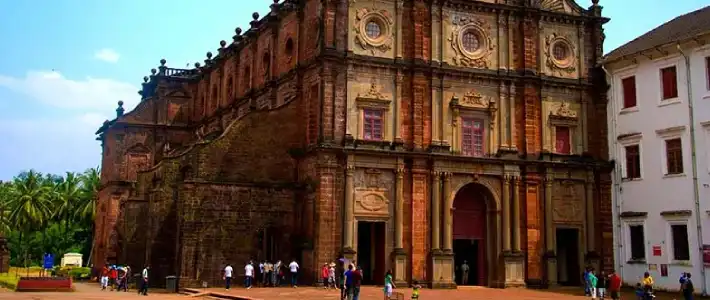
Old Goa contains the Basilica of Bom Jesus, its most honoured and famous religious structure. The conduct of religious services began at the Basilica of Bom Jesus when it opened its doors in 1594 and formally dedicated the church for use in 1605. This sacred space now stores St Francis Xavier's remains as the town's patron saint. The church stands as an extraordinary work of architecture, which combines Baroque with Portuguese colonial features. Visitors are captivated by this religious structure due to its gilded altars, marble floors inlaid with precious stones, and intricate carvings. Every ten years the body of St Francis Xavier appears inside a glass coffin for a grand exposition which attracts thousands of pilgrims from all continents. This basilica stands today as a major religious and historic attraction that continues to be devoted to by local citizens.
Se Cathedral
The Se Cathedral represents one of Asia's biggest churches since its location fronts the Basilica of Bom Jesus. Saint Catherine of Alexandria receives worship at this place, which marks the Portuguese military triumph over Muslims on her holy anniversary date. The building shows characteristics of both Portuguese-Gothic and Tuscan architecture. The "Golden Bell" found at this place serves as the biggest bell in Goa while standing among the best quality bells in the world because of its extraordinary sound. Eyewitnesses can feel a deep spiritual atmosphere when they encounter the vaulted ceilings, ornate chapels and sculpted altar carvings which demonstrate Portuguese colonial wealth.
Church of St Francis of Assisi
Near the Se Cathedral stands the Church of St Francis of Assisi, which displays both artistic perfection and architectural simplicity. Construction started in 1661 to create a masterpiece that combines Manueline architecture with Baroque interior design. The exterior of this church showcases three architectural styles, complemented by exceptional wood carvings, enhancing its overall aesthetic. The main religious space contains floral ornaments and artistic portrayals of St Francis of Assisi's life. The convent located inside this house now operates as an archaeological museum which unites historical artefacts and religious buildings under one structure.
Archaeological Museum of Goa
Within the Franciscan Monastery visitors will find the Archaeological Museum which presents an exciting opportunity to study Goa’s cultural evolution. The Archaeological Survey of India maintains the museum which presents Portuguese and pre-Portuguese artifacts alongside sculptures and portraits as well as stamps along with weapons. The location displays both portraits of former viceroys alongside prehistoric stone writings together with historical Indo-Portuguese architectural features. A visit to the museum shows how Goa transformed through time from the Kadamba dynasty until Portuguese colonial dominance reached its peak.
Church of Our Lady of the Rosary
A hilltop location gives the Church of Our Lady of the Rosary its place as one of the oldest places of worship in Old Goa. Built in 1547 with Renaissance characteristics and Gothic and Manueline architectural elements the structure stands complete. The Portuguese general Afonso de Albuquerque has a strong historical link with this particular church where he conquered Goa. A simple yet elegant Virgin Mary altar stands at the center of the building inside. From its hilltop position the church offers vistas of Mandovi River along with lovely countryside panoramas for visitors seeking peace among pilgrims and visitors alike.
Chapel of St. Catherine
The Chapel of St. Catherine maintains a significant historical position because Afonso de Albuquerque constructed it in 1510 after securing Goa from the Bijapur Sultanate. Despite its minimal dimensions the building represents the start of Portuguese power in this part of the world. Both the chapel and its walls and roofs are built with laterite stones while using tiles for their roofing. The Chapel of St. Catherine maintains deep value in Goan colonial history even though its size remains less grand than other sites such as the Se Cathedral and Bom Jesus Basilica.
Church of St. Cajetan
St. Peter’s Basilica in Vatican City served as the main inspiration for the Church of St. Cajetan which utilizes Corinthian columns alongside a domed design. During the middle of the 17th century Italian Theatine friars constructed the church which combines European architectural traditions in a remarkable way. Inside this place of worship members will encounter Our Lady of Divine Providence as the main altar while the interior walls display multiple paintings and ornate woodwork and pillars. The site contains an ancient well which appears linked to a discontinued Hindu temple yet was constructed in 1783.
Viceroy’s Arch
Francisco da Gama constructed the Viceroy’s Arch in 1597 as a lasting symbol of Portuguese rule even though he descended from the famous Vasco da Gama. Through its history this ceremonial entrance permitted Portuguese viceroys to welcome their arrivals by sea. The arch displays twin shields of the Portuguese royal family emblems together with a Vasco da Gama statue. Today the historical photo spot of Viceroy's Arch continues to represent Portuguese colonial influence in Goa.
Monte Hill and Chapel of Our Lady of the Mount
Taiwan Hill maintains its status as an incredible but understated destination among the locations of Old Goa. You find the Chapel of Our Lady of the Mount standing at its position on top of the hill which was built during 1510. Despite being reserved for public visitors, this chapel welcomes people at the annual Monte Music Festival each February through its limited openings for classical music enthusiasts. Visitors can enjoy breathtaking views that encompass Mandovi River and Divar Island and the extensive Old Goa ruins during sunsets and peaceful reflection.
Ruins of the Church of St. Augustine
Visitors to Old Goa can witness the melancholic remains of the Church of St. Augustine to experience the former glory of this historic location. The church was constructed in 1602 by Augustinian friars at a massive scale until Indian administrators left it empty in the 1800s which eventually led it to collapse. A remaining 46-meter-high tower stands as the only survivor among the collapsed nave and altar ruins of the site. The abandoned church ruins attract history enthusiasts and photographers who admire their atmospheric presence after they became famous through filmmaking. People become intensely nostalgic and curious when visiting this place.
Museum of Christian Art
The Museum of Christian Art presents a distinctive collection of art inside Santa Monica Convent which combines European religious elements with Indian artistic practices. The collection of objects encompasses elaborately carved sculptures together with religious tools and embroidered sanctuary vestments as well as beautiful altar pieces. This museum exists to conserve Goa's exclusive Christian artistic legacy while attracting both historians of Christian art and those who simply want to learn.
Conclusion
Old Goa stands above other locations because it exists as an ongoing display for religious devotion together with cultural and artistic content. Each religious structure throughout Goa bears sacred tales that reflect the colony's religious heritage and colonial period. Old Goa provides its visitors with an enriching complete experience for those who follow religious pilgrimages as well as for history lovers following Portuguese paths across time or architecture lovers seeking timeless structures. As you make your way through the warm streets and echo-filled monuments of Old Goa the place grants itself into your heart and stays with your spirit following your departure.